Wednesday, October 28

Casablanca


* Spoiler Alert *

Casablanca takes place during the war era. It is a place in which people stop by as they travel/escape out of Europe. As the WWII rages, desperation grows because people want to flee the dangerous situations. This city is an optimal spot for a restaurant, as Rick set up. Rick, the club owner (Humphrey Bogart), has various relationships with both the customers and also other townspeople. In general, it is a character that is respected by others, but not friendly and intimate. His stoic attitude changes as Victor Laszlo (Paul Henreid) and Ilsa come into town. Victor is a fighter for Czech Resistance and stirs up trouble with the German Nazi officials. Ilsa, his beautiful date, was once involved with Rick in former years. As Rick and Ilsa reconcile their love affair in Pairs, Rick is reminded of his deep wound as Ilsa mysteriously left him. Although Ilsa and Rick do have a passionate deep burning love for each other, their ideal situation of being together is weight by Ilsa’s marriage (to Victor). As Ilsa, Rick, and Victor attempt to revolve their love triangle, the presence of the Nazi officials heat up the tension and restlessness of the soon-to-be refuges. What will be the result of the officials? Will Ilsa and Victor stay together because it is the moral thing to do? Or will Rick and Ilsa be able to truly love each other like it was meant to be all those years ago?


This movie is full of a wonderful cast. Although there is a romantic plot, there are also other interactions of supporting characters that focuses on life outside the romance. A life is happening outside the love triangle which is entertaining. Rick’s Restaurant is guaranteed to be full with entertainment, despite the gloomy and solemn times outside of Casablanca.


I personally enjoyed the decade (setting) and the culture appropriate props. If anybody else likes the 40’s, romance, and Humphrey Bogart, then you will definitely enjoy traveling to Casablandce.

Note: Again, I understood the French they spoke in Paris! Bonjour Paris!

Thursday, October 22

Bonnie & Clyde


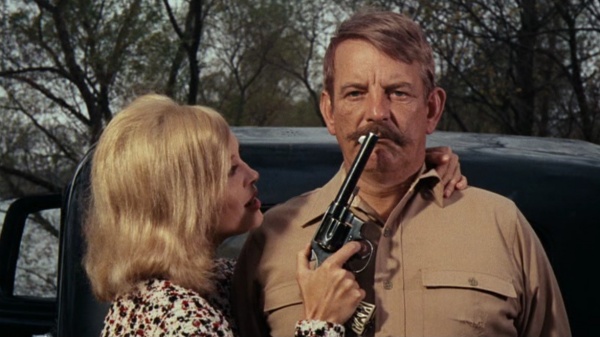
Bonnie and Clyde, 1967, is a move in which one can easily be swept up in. Bonnie and Clyde meet up only as change and went on a journey together. When Clyde attempts to steal Bonnie’s mother’s car, it is clear that he was her ticket out of the rundown hopeless town she was in. Clyde is a bank robber by career and Bonnie joins him to form an act. As they perform faulty but entertaining robs, like stealing from a bank that is already bankrupt, they seem to really want to live in a fantasy world with no rules. Their schemes continue as they travel across states and meet up with equally quirky (sometimes annoying) character, like a car mechanic, and Clyde’s brother and his wife. Soon, the whole gang bang tries to perfect their act while living on the run. As their antics continue, the stakes get higher and more dangerous. Quickly, their crimes are well known not only in their state, but also around the world. As Bonnie and Clyde (plus the other members of the gang) and their fame grow hungrier for more action, their relationship changes and they doubt morality of their career.


  Bonnie and Clyde have a carefree and somewhat reckless attitude. This charisma makes them likeable and amusing to watch. This Hollywood movie is different from previous ones in that the “bad villains” are rather comical and have some moral consciousness to them. Even though they do rob banks, they mean no harm to most people rather they just want a better life than what their bank accounts could afford.


Sunday, October 18

Analysis of Run Lola Run


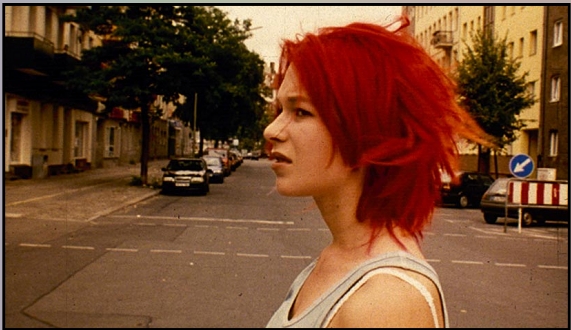
Since the majority of this movie is based upon the view of the story through cuts and shots, cuts and editing are very crucial to portray the events properly. As Lola runs through her situation, it is clear that her actions impact others. So, the shots of both Lola and supporting actors are used in a way to emphasize the plot. For example, Lola receives the phone call from Manni which sets off the snowball effect. Here, as she gets ready, there are quick flashes between the shot of her face and her realization about her situation. Earlier in the day, the moped was stolen which sparked the succession of events. Here, the changes of shots between Lola talking on the telephone narrating and the black and white shot of the earlier events. It is perfectly planned that the moped theft events were in black and white because it was easy to identify the picture as in the past. When I think of black and white, I think of older times when color was not available. Often, it is used as a reference to the past or dreams, etc. It works here because it shows the difference between the black and white (also, reference to silent pictures) to the color and voices of Manni/Lola’s conversation. So, the use of black and white makes the story easily identifiable to the past.

Continuing with this opening phone conversation, the use of shock cuts and shot/reverse shots are used frequently throughout this film. For one, it is used during the phone conversation. Manni explains how he took the subway and how he left the bag with the money on it. They repeat “the bag” in a repetitive beat about ten times. The stability of it reminds me of a heart beat. Plus, the emphasis on the techno music is used as well. The loud bass beat increases as Manni and Lola say “the bag.” These in combination show the continuity of the editing style. Not only do the actions match (physically saying “the bag” ten times), but also the music (European bass blaring techno music) and the events that are happening (heart racing stress) run parallel to the experience of the film.

Another example of this heart racing experience of the film would be after Lola and Manni get off the phone. It was expected of her to think of a plan quick on her feet. Just like normal situations, the heavy burden of the stress eats her up. Lola, trapped against a wall, attempts to think of a plan. Here, the imposed shots of Lola looking at a clock and attempting to rapidly think of a plan. Again, the shock cuts are used and it expresses a jolting image. As she grabs her hair (almost pulls it out), she starts thinking of people who would give her the money. It is easy to see this because pictures of people are imposed in between shots of her, like she is thinking about them. As these shock flashes are used it is clear that they give a jarring effect. The quick and rapid succession between her face shot (circling around her) and the whispering narration make it clear that her heart is racing, she is stressed, and it adds to the direness of the situation. Obviously, the editing here is used to present the whole package. If one or a couple of these elements were not present, it would not send such a strong message as it does. Again, without this editing, the continuity would not have made as much of an impact as it does.

Friday, October 16

Run Lola Run


This German film is a series of domino effects. Manni, a man whom is involved with the wrong drug crowd, is in trouble because he could not follow through on his assigned drug deal. After selling drugs and making 100,000 marks, Lola would pick him up on their moped. Since their moped was stolen, Manni was forced to take the train. Then, he ran into a homeless man and police. After he realizes that the homeless man stole the cash, Manni calls Lola in a panic. Lola tries to think of a plan to Manni is not killed from the drug lords. They have exactly 20 minutes to make a plan to get the money back and stay alive. Through her scheming, a series of cause and effect events occur. They need to get 100,000marks back, but numerous occurrences could have changed the course of their plot. The events that happen in the 20 minutes are crucial. If their actions had been altered by just a few minutes, then their whole fate could have changed. Yet, the dilemma between the actual events that did happen and what could have happened is constant lingering mystery. As they explore the possibilities of choosing different actions, Lola and Manni are faced with small choices that change their life (or their possible lives) forever.


Personally, this movie is not one in which I enjoyed mainly because it made me very motion sick. Through the constant handheld filming perspective and the constant running, the actual movie quality was rough. The decision not to have track shots makes sense because the handhelds allows for the audience to feel the motion of Lola running. Another thing that made me physically nauseous was the techno music. Although it is meaningful to the movie and the misé-en scene, the loud bass is not for me. I guess, this movie is not for me because I do not like techno music nor do I like the shakiness of the filming. Without these things, I would like the plot and the characters.

Friday, October 9

Analysis of Do The Right Thing


Do The Right Thing, is clearly loaded with lots of cultural and racial stereotypes. Spike Lee uses these, usually negative, assumptions people have of other people to prove his point that this world is not as it is supposed to be. This movie is refreshing because it does not seem to hide nor skirt around some pretty intense controversial issues. I have heard different interpretations and analysis of this movie, but I would not want to taint your viewing of it if I shared mine. I did not see this movie before, so I came to it with an open (maybe clueless?) mind. If things would have been different and I heard interpretations of it before I saw it, I would most likely have a very different perception in my head about it.


Instead of focusing on the numerous culturally significant interpretations one can have about this movie, I will focus on the editing of the scene with the race ranting. **Spoiler alert- this may give some of the movie away*


In the scene before, Pino (one of Sal’s son who is particularly vocal about his belligerent racist views) and Mookie have a discussion. Mookie attempts to reason with him, attempts to show some logic about how Pino has idols like Magic Johnson and Bruce Willis, but hate other blacks. Pino denies such subtle accusations from Mookie (whom he does not have a high level of respect for) and the tension grows between the two. The scene is cut by having Mookie and Pino standing in between a cigarette dispenser and a picture of Rome’s Coliseum and Arch of Titus (two-shot) and then the scene unfolds as Mookie and Pino disagree about his idols. When Pino does not agree (does he defend his own thinking?) with Mookie’s point, the camera references back and forth to each other as they speak and present their issues almost as proving as they are on different sides (shot/reverse shots). So, they have different shots representing how the flow is happening. Once they disagree, it seems to be jarring and there is a lot more movement. This movement and rapid succession happens when people share their boiling points about other races. Mookie, once level headed and somewhat rational, now has a shot all to himself in which he is loud, angry and venting. The camera zooms right into his face and Mookie has his arms crossed. This is the part that Spike Lees allows the audience to really feel not only defensive (since the zoom is so close, it feels as if somebody is invading personal boundaries) but also very focused on what he saying. The camera editing is very intentional with putting the camera dead infront of the character and progressively zooming. As the shot moves to the next character, the motion is similar. This pace and movement of the camera as it focuses into the character seems to be equal as each person has their gripe about another race. The equality of time allows for some sort of rhythmic repetition to happen. Overall, this scene has purpose editing in terms of the first scene, where Pino and Mookie are purposefully split from the shot together and then placed in opposition to each other, and also when the zooms and rhythmic repetition are used for each character to spew their stereotypes at the other race. Although this scene is somewhat harsh on ears (because some of the stereotypes hit too close to home and are more honest than we may be willing to be), it is important to view for original editing abilities.


Wednesday, October 7

Do The Right Thing


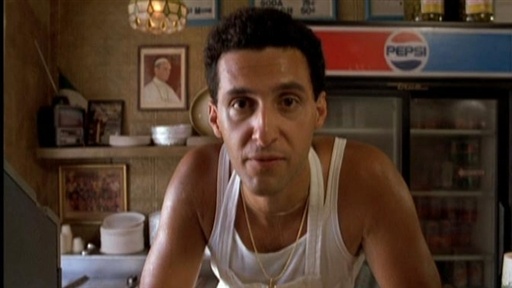
Spike Lee’s, Do The Right Thing, premiered in 1989 and since then has been one of a kind in its portrayal of culturally relevant issues. This movie follows a hot summer day in the life of a street in which businesses, workers, customers, friends, family, and neighbors interact. The main business, Sal's Pizzeria, is owned by Sal, but his two sons, Pino and Vito, and Mookie assist him. Mookie is the delivery man and much of the movie follows his interactions on his ‘routes’ and his relations with his neighbors. The plot is focused around a situation in which Buggin’ Out claims that Sal’s pizza shop, although located on a ‘black neighborhood,’ should have black celebrities. Throughout the rest of the time, Buggin’ Out tries to start a boycott against Sal’s, yet nobody seems to join him except Radio Raheem. As the rest of the quirky characters, like Da Mayor, Mother Sister, Mister Senior Love Daddy, Jade, and the local gang, go about their day, there is a constant oppressive feeling from the heat and culture stigmas/rules. The day is full of examples in which culture is such an issue. Stigmas and assumptions are made, but it is barely held off by respect. A sense of hostility always seems to be very present, even though they do not physically display violent actions. Eventually, Buggin’ Out and Radio are so fired up they are faced against Sal and his sons. Mookie and the rest of the street are attempting to figure out what the “Right” thing to do is. Hate and love (passion) are both present, but which is the right one?

This movie is definitely loaded with heavy situations and does not seem to avoid much. The characters banter to each other about daily life routines but it carries a larger sense of how the ‘system’ functions. As they attempt to survive the heat, they also try to survive living close to other people that have very different opinions, practices, beliefs, ancestry, upbringings, and culture. The clashes from these different lifestyles cannot always be muffled, but they cannot always be expressed. What is the right balance between them? What is the right thing to do?

Tuesday, October 6

Analysis of The Godfather


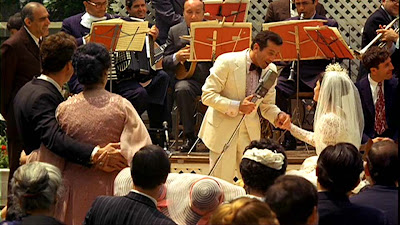
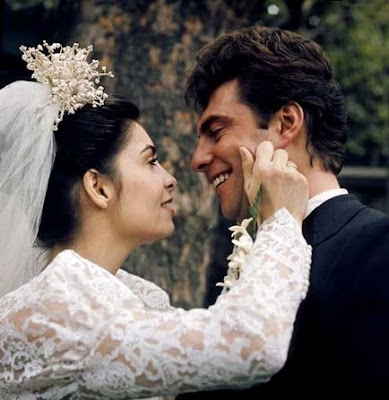
When watching the Godfather, it was easy for me to be put in the place of the setting. Unlike The Diving Bell and the Butterfly angle shots that placed me in Jean-Do’s paralyzed position, The Godfather used props and sets to enhance the setting. The opening setting is a 1940’s Italian family’s wedding. Without words, I was able to tell that I was in a different decade and I could identify that they are wealthy. Through the dresses and suits (typical in the 40’s fashion... and so fashionable nowadays), I was able to tell that the outfits (costumes) are quality material and the number of layers/lace on the actual wedding gown seemed to cost a lot. Plus, the decorations (balloons and flowers) were extraordinarily expensive. I worked in a flower shop for years and I know the price of each stem of calla lily, rose, lisianthus, etc, in the arrangements. These are not cheap flowers, even for now. And since shipping/transporting flowers internationally was not available as it is now, it would have been that more expensive and rare to have these. Besides the expensive flowers, the cars in the driveway also are lined up. It is almost as if everybody has money and they all can afford nice cars. The number of guests is exorbitant as well. I am aware that they have a large family, but they all fit outside the Corleone’s house which makes the Corleone’s live in on a lot of land and have a lot of guests to pay for. The band to entertain the party guests fits along with the decade and also it is a large sized band. Even now, I don’t think I will be able to afford such a large band. The last thing about the wedding which shows that they are wealthy/influential and the people surrounding them are wealthy is the size of the cake. The cake is extremely tall and many layers to it. All of these props may seem unimportant and microscopic, but they all convey the naturalistic idea that this family has power and money. This is one of the opening scenes and it shows that there wealth and affluence to this family. I understood of all that from about 15 minutes of the movie. I understood the time period and the social status.

Wednesday, September 30

Movie Review - The Godfather


This movie follows the story of the Corleone family as they are involved in the Scilian Mafia in NY during the 1940s. Competing against the top 5 Mafia families, they attempt to keep their power and fear among the others. Unfortunately, as other families want to get involved into the drug business, Don Vito wants to keep his business more “pure” (if one can accomplish that in the Mafia business) and more respectable. It is obvious that the Godfather has the most power, but he gains it through respect or forced loyalty. As the family experiences marriages, births, and deaths, the Corleone family has to decide what their future holds in their family and business. The Godfather could be reported as a story in which there is much violence and killing to keep a business growing. Yet, it could be a story about family and trust. The relationships between people are interesting, some are very dynamic and some are very static. In the beginning, it is very difficult keeping the characters straight. Remembering who is who and their relationship in the family would take another viewing for me to easily recognize. I liked how the movie focused on a few different people at different times. The whole thing was not based around “The Godfather,” there were parts in which it would follow the brothers and the different tasks. It shows how each member is different, so how they perceive and act in the family varies. It is also interesting to study the relationships of generations or genders. Normally, the men have certain tasks and the women have tasks in which are not supposed to interfere with the men. And, the power is dependent upon one’s generation. Overall, I think this movie has a good balance between “shoot-em up” and “chick-flick” relationships in which everybody can appreciate, if not enjoy.

Tuesday, September 29

Analysis of Apocalypse Now


Apocalypse Now has a few main aspects of cinematography in which it is recognized and distinguished as a great movie, espec
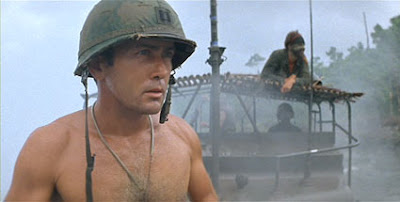
ially the aspects of color. For one, the color of the movie was a constant reminder of how choosing a color scheme can be so powerful. In the beginning of the movie, we view Captain Willard as he waits for his mission. Once he gets the mission and heads to the jungle, there is an obvious visual pattern in the jungle and the war, fire (yellow, oranges, reds). Fire has been consistently been part of the movie. The beginning of the movie shows blood as he punches the mirror and then there is the shrimp while he gets his mission. Then he is stuck in war and there is clearly lots of blood and fire there. In fact, Lieutenant Colonel Bill Kilgore (the surfer) wears a yellow scarf around his neck.


And it continues until Captain Willard gets really deep until the jungle. When he gets close to the crazy Kurtz, the scene gets very dark and misty. There is a lot of fog and darkness. Once he reaches the ruined city Kurtz changed, there is a lot of yellow and oranges in the city. I think it is supposed to resemble the fires that are burning (which also are symbolic) and the reflection from those fires. From the camera angles and highlighting this, it makes it obvious that the colors are not a coincidence, it was planned and arranged.


Then, it is clear how yellow and shadowing cinematography is used when the climax happens. When Capt Willard finally finds Kurtz, there is not a full shot of his looks for a while. I get snippets and undistinguishable angles of him in which I cannot form a look together. By not being able to see his full face, it is very difficult for me to personify Kurtz. The yellow makes it seem much more glum and conveys the image in which Kurtz has more power and fierceness than he actually does. By planning and organizing the shadowing, it changes the basic image and it changes the emotion it makes. Personally, I feel as if Kurtz is more inhuman and much more evil because I cannot picture him as a human. I cannot picture him as a man and performing such horrific acts to the village members. Once I do view Kurtz, he isn’t so scary and intimidating, I do not feel as if his evil is omnipotent anymore. Through the cinematography, a different angle

may evoke a different feeling and mindset towards the story.

Wednesday, September 23

Movie Review - Apocalypse Now


During the Vietnam War, U.S. Army Captain Willard (Martin Sheen) is delivered an assassination mission. This classified “nonexistent” mission requires Willard to travel to the forbidden lands of Cambodia and kill the Green Beret Colonel Walter Kurtz (Marlon Brando) who has apparently gone made with power, branched off American forces and used his military prowess to make his own missions against the natives. As Capt. Willard attempts maintain his undercover position and privileged information, he is forced to make important decisions regarding his journey, the boat crew, plans, and his own conscience of killing a fellow American soldier. Capt. Willard struggles with his conscious if he will indeed murder a soldier and struggles as he attempts to trek the long journey. Will the forbidden lands destroy him or will his own soul destroy him first?


During and after watching this movie, I did not only dislike it, but I also was extremely confused on the aspects of the mission. It was obvious that Capt Willard had a mission, but the mission of the movie was pointless to me. I did not think differently or view the world differently, or have a better understanding of life. I did not feel changed or impacted, so I feel as if watching this movie was a waste of time. The climax of me being lost and dumbfounded was the point when Willard’s boat crew stops for a “routine check” and their actions with the natives. The thing I liked about the movie is that it showed its expertise of shadowing and light. The shadows through the trenches, the river, and through the camps were astonishing. But if I could change this movie to make it better, I would take out a lot of the guns/bombs (but realistically, violence is involved during a war), edit the narration voice and script, change the character development (especially Willard/Sheen), and definitely add some respectable female in the mix. If you do not like movies with lots of shooting, death, blood and guts, then this movie is not for you. Usually, I can overlook the gore and grossness, but the plot was just as gruesome to experience.

Tuesday, September 22

Analysis of The Diving Bell and the Butterfly

After watching The Diving Bell and the Butterfly, I already had a first impression of the movie. Overall, I thought it was a beautifully sad and moving life. The second time I watched this I realized that the movie had many more dimensions that just the characters’ interaction and development. For one, the opening scene has a very blurry frame and it is set at a very low point of view. From this low position, I am expected to feel like I am actually the character, Jean-Do, who is in a hospital bed. The camera movement, most likely on a handheld, is accurate in the sense that it attempts to portray what a paralyzed person feels. No movement of the “neck” (handheld, again) allows the attention to be on the focus and depth of field. In this opening scene, not only is the camera position low, but also the depth of field is very limited. At most, a hospital room is 10 feet from the bed to the end of the room. Ten feet does not provide a very spacious feeling, rather, it feels claustrophobic and constraining. Also, Jean-Do’s “eyes” attempt to take in as much information as possible, so they range from a very deep focus to a very blurry shot. This iris shot directly relates to how Jean-Do experiences his new perspective. At one point, we see the stubble on a doctor’s face and we can almost see ear hair. If anybody has ever had to get their eyes checked and they get the eye drops, this is what the camera does. It goes from very blurry, almost as if there is a water-like film over the vision, to a very crisp deep focus. The position of the camera, paired with the deep/lack of focus and limited depth of field conveys the constraining feeling one feels in a hospital bed. From Jean-Do’s position of the hospital bed, it also has very skewed angles, also known as canted frame. It is obvious that the camera is a handheld and not set on a tripod well until the second or third scene. This could symbolize how Jean-Do is unconscious and unstable (handheld) to when he begins to recognize and consciously understand his surroundings (tripod). Overall, the beginning shot to me was one of the most important because it easily set me into his position. I could already relate to Jean-Do because I have experienced the constricting hospital room setting. Being put into Jean-Do’s head was a brilliant and effective idea for me to easily share and associate myself with the main character. Je suis dans la tĂȘte du Jean-Do!

Wednesday, September 16

Movie Review - The Diving Bell and the Butterfly

Last evening, we watched The Diving Bell and the Butterfly, during class. The movie opened up to a series of images that went from incredibly blurry to clear and crisp, then back to blurry. The audience realizes that we are Jean-Dominique Baudy position. Jean-Dominique (Jean-Do to friends) had been in a coma and suddenly woke out of it. Yet, he has an acute paralysis diesease, known as locked-in syndrome, which leaves him controlless from his head to his toes. The only remaining body part in his control are his eyes. The rest of the story is him remembering his previous healthy life and attempting to rehabilitate from accident. From a series of positive and hopeful nurses, to previous women in his life, and some friends, Jean-Do begins to realize his current world is very different from his previous one and begins to accept his new "normal" lifestyle.
I would say that this movie is tres bon ("very good", in french). Personally, I think I was half distracted with them speaking French because I could kind of understand them. (Mimi-we should watch this movie together! Vous regardez les film avec moi, s'il vous plait! Thanks to summer French class, I was brushed up and ready to watch). This movie, regardless if you speak French or not, was beautifully sad. This man is completely depedent on other people, which he is not used to and also feels helpless. I think I liked the parts where Jean-Do realizes his regrets, like he could have been a better father, and where he begins to love again, like how he takes trips to the lighthouse and lives through his imagination. Overall, this movie is wonderfully moving in the fact that a person, who is completely paralyzed, begins to become a human and experiences regular human emotions of great joys and deep sadnesses. Le film est tres bon, mais non tres bien parce ce c'est retarder, un pou. J'aime The Diving Bell and the Butterfly, au revior!