Showing posts with label Analysis. Show all posts

Sunday, December 6

Citizen Kane


In the opening of Citizen Kane, Charles Foster Kane dies as a pathetic sad man babbling about things like “Rosebud.” However, Kane lived an extraordinary life in America’s spotlight. As a tribute to him, Thompson, a news reporter, attempts to find the story behind rosebud. Through the people close to Kane and their interviews, we witness Kane as a boy living a hard life. Coming from a poor family, his parents thought it was best for him to live under Mr. Thatcher’s guidance. Here, he was comforted with the materialistic finer things in life and given financial opportunities. Eventually as a young man, he aspired to open a newspaper and became well-known. He bought out the NY Daily Inquirer and transformed previous newspaper history. Here, he started an empire across the nation. Plus, he got married to his first wife, but things ended dreadfully between them because Kane was accused of being with another woman (eventually his second wife, Susan Alexander). As Thompson digs deeper to try to unearth the rosebud mystery, it is clear that Kane lived a life full of possessions and money, yet he was plagued because he missed the human necessities of life, like love and tenderness.


Citizen Kane, in my opinion, was not the best film ever made. In fact, I would put it only on my top 100 favorite list. For me, a favorite movie has to have a few aspects in it. One, it has to have a lot of character interaction and relationship development. Something I have noticed is that I understand the story better when I understand the characters and their relationships. Normally, I am not interested in the cool graphics and fancy technological features; rather, I am drawn towards the meanings the characters create. Since I am a potential Interpersonal graduate student, it is obvious that I like movies with strong emphasis on relationships. For Citizen Kane, I was not personally attached to him. Although the film is not first person narration, it does revolve around Kane. I mean, he is the title of the movie! However, the film unfolds through others’ perceptions of him. Through a news reporter’s investigation a mysterious keyword, Charles Foster Kane’s life story plays out. Indeed, this part of the film was creative and broke the rules of first person narration, yet, I had a difficult time relating to Kane. Just like any other audience member, I saw him as a distant celebrity in which I was just following his life. It is parallel to the opening of the film through newsmarch, where the audience has a reader’s digest preview, but just like the audience watches the news, it seems somehow fake. I am not sure of how to exactly describe it, but it is almost as if the person is less human when they are portrayed in the news, close to an out of body experience (this could also relate to how I have been trained to idolize people in the news). For whatever the exact reason, I like films in which I can perceive the world through the main character’s eyes and in Citizen Kane, it was somewhat difficult to have an instant connection and understanding. Again, a big reason this film is not under my top 10 list is for the very reason that makes it creative and probably more well-liked: lack of first person narration.


A second reason this film is not the greatest film, not even top 10, would be the fact that it is in black and white. I know, there could be a debate about this and I probably should not not like a movie just because the technology was not up to date. For me, my eyes sometimes go bonkers when I watch a movie in black and white. Yes, I do think it is somewhat romantically reminiscent of older times; still, I don’t enjoy them as much. (Goodness, I hope this secret does not fail me out of film class!)
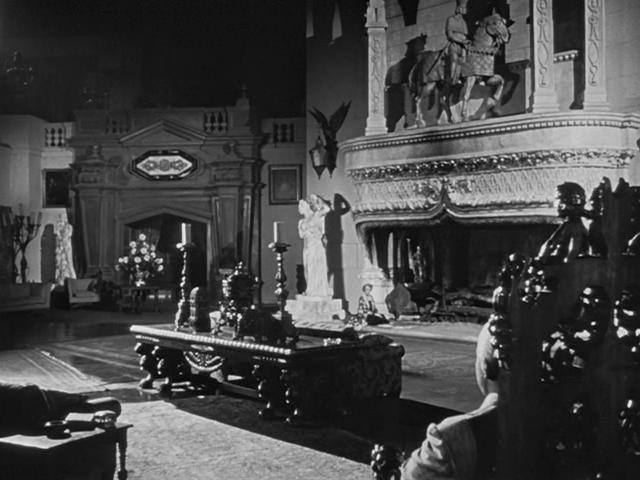


Despite the reasons that I do not think this film is the greatest of all time, I can see how other people (probably ones that appreciate black and white) do think this. For one, this film has innovative filming techniques. Orson Welles, actor and director, created a film that was like none other. A few scenes that stick out in my memory as brilliant technique would be the scene with the front shot of Susan Alexander (second wife)’s opera debut and the same scene, but from behind following the back shot, the shot with the Chronicle editors in the front window and then the actual photo shoot, the continuing sled prop shot (it shows him playing in the snow by himself, then when he was “sold,” then how he hates a lonely Christmas and his new life), the shot with Kane celebrating with the dancing girls in the window because it shows how he is omnipresent with his company, and finally the shot with Kane and Susan in Xanadu when they are standing about 50 feet away from each other in an empty massive room. These shots not only establish high-quality techniques, but also help the plot along. It makes sense that Susan and Kane were unhappy and had intimacy issues when they stand what seems to be a football field away from each other.


Overall, this movie can peak both film critics/students/buffs and also the average audience member. For myself, I have never seen this movie, nor did I know the ending of Rosebud or really have any expectations for it, and I would definitely watch it again. This movie deserves a second chance because there are minuscule details that I missed the first time around. It may not be the greatest movie ever made, but it is great and made well.


note: Is there some motiff with glass doors, windows, and mirrors in this movie? There seems to be a lot of them!

Friday, November 6

Classical Hollywood Narration or American Narration?


Classical Hollywood Narration or American Narration?
                While watching Monsoon Wedding, Daughters of the Dust, and Casablanca, it seems clear to me that these three different movies represent a bigger cultural narration clash.  In order to further discuss this, I need to first define what “classical Hollywood narration” is.  Usually, it consists of a few things like the plot centered on a couple of main characters whom have certain goals, a linear time sequence, or the presentation (that the movie is meant to be realistic instead of abstract).  Opposite of this, the alternative film narration focuses around not a few characters, but rather groups, is less realistic, and defies the rules of directional narrative.
                Casablanca, made in 1942 during the Hollywood assembly line age, is about Rick Blaine’s story as he lives in a destitute town during WWII.  In this classic black and white romance, Rick’s story focuses mainly on his life. 
                Daughters of the Dust, produced by a woman in 1991, is a story about an African family living in North Carolina stuck between the decision either to honor the ancestors or live a better life off the island.  Here, the story takes place mainly through the women’s conversations and their viewpoints.
                Monsoon Wedding, a 2001 ‘westernized’ version of a classic Bollywood, is about a family planning a wedding and all of the traditions involved.  The family has many individual struggles; however, they are brought together for their common union for each other.
                These three movies are different for a couple reasons like, like they are made in very different time period or the basic plot of the films are different.  However, there is a main difference that I noticed that separates Casablanca and Daughters of the Dust / Monsoon Wedding.  According to the general guidelines for a classical Hollywood narration, the story is supposed to be focused on one or two main characters.  In Casablanca, Rick and his long-lost love Ilsa are arguably the main characters besides a few side plots (like the Nazi soldiers and Victor Laszlo).  The audience knows his past thanks to a flashback, his present, and some of his future actions. 
However, Monsoon Wedding and Daughters of the Dust are very different.  Again, the basic premise of the plot is one in which involves around a family.  Instead of a singular character, it is around the interpersonal relationships and family communication the family system has.  The Peazant family, of Daughters of the Dust, face new decisions between traditional ways and the pioneering ideas of moving.  The Verma family, of Monsoon Wedding, has to plan a wedding for their prized daughter, but are stuck in how the family dynamics will change.  Again, these plots are vastly different.  Yet, I have to ask what makes Casablanca classical Hollywood narration while Daughters of the Dust and Monsoon Wedding are not considered classical Hollywood narratives. 
The main thought here comes from that Casablanca is not necessarily “Hollywood” narration as it is “WASP” narration.  Most likely, the producers of this movie are White-Anglo Saxon and have typical American values, like individualistic and reparation.  So, I am curious on what makes it classical Hollywood narration as it could be the white hegemony values. 
Compared to this, other cultures have different concentrations.  Here, I think of how Indians are much more collectivistic.  It totally makes sense that the movie would be dependent on a family’s interaction with each other instead of a single individual.  Indian families are normally very close.  Different behaviors and lifestyles make their interactions more frequent.  It makes sense that Indian marriages are arranged and family approval is necessary.  
Likewise, African families rely heavily in generational value.  It is important for families to appreciate their older members.  So, Nana Peazant, the matriarch, would have a strong voice in the family.  Their present actions are defined by the past actions, so time does not happen in a linear fashion.
The cultural differences brings me to the point that the classical Hollywood narration is characterized more inline with WASP culture instead of particular film qualities.  The alternative narration guidelines are focuses mostly on other international cultures.  (note: I know that Hollywood has a much more successful film business, but my point here would be to include more diverse culture narration guidelines so it does not seem as wasp centered as it does to me)


Sunday, October 18

Analysis of Run Lola Run


Since the majority of this movie is based upon the view of the story through cuts and shots, cuts and editing are very crucial to portray the events properly. As Lola runs through her situation, it is clear that her actions impact others. So, the shots of both Lola and supporting actors are used in a way to emphasize the plot. For example, Lola receives the phone call from Manni which sets off the snowball effect. Here, as she gets ready, there are quick flashes between the shot of her face and her realization about her situation. Earlier in the day, the moped was stolen which sparked the succession of events. Here, the changes of shots between Lola talking on the telephone narrating and the black and white shot of the earlier events. It is perfectly planned that the moped theft events were in black and white because it was easy to identify the picture as in the past. When I think of black and white, I think of older times when color was not available. Often, it is used as a reference to the past or dreams, etc. It works here because it shows the difference between the black and white (also, reference to silent pictures) to the color and voices of Manni/Lola’s conversation. So, the use of black and white makes the story easily identifiable to the past.

Continuing with this opening phone conversation, the use of shock cuts and shot/reverse shots are used frequently throughout this film. For one, it is used during the phone conversation. Manni explains how he took the subway and how he left the bag with the money on it. They repeat “the bag” in a repetitive beat about ten times. The stability of it reminds me of a heart beat. Plus, the emphasis on the techno music is used as well. The loud bass beat increases as Manni and Lola say “the bag.” These in combination show the continuity of the editing style. Not only do the actions match (physically saying “the bag” ten times), but also the music (European bass blaring techno music) and the events that are happening (heart racing stress) run parallel to the experience of the film.

Another example of this heart racing experience of the film would be after Lola and Manni get off the phone. It was expected of her to think of a plan quick on her feet. Just like normal situations, the heavy burden of the stress eats her up. Lola, trapped against a wall, attempts to think of a plan. Here, the imposed shots of Lola looking at a clock and attempting to rapidly think of a plan. Again, the shock cuts are used and it expresses a jolting image. As she grabs her hair (almost pulls it out), she starts thinking of people who would give her the money. It is easy to see this because pictures of people are imposed in between shots of her, like she is thinking about them. As these shock flashes are used it is clear that they give a jarring effect. The quick and rapid succession between her face shot (circling around her) and the whispering narration make it clear that her heart is racing, she is stressed, and it adds to the direness of the situation. Obviously, the editing here is used to present the whole package. If one or a couple of these elements were not present, it would not send such a strong message as it does. Again, without this editing, the continuity would not have made as much of an impact as it does.

Friday, October 9

Analysis of Do The Right Thing


Do The Right Thing, is clearly loaded with lots of cultural and racial stereotypes. Spike Lee uses these, usually negative, assumptions people have of other people to prove his point that this world is not as it is supposed to be. This movie is refreshing because it does not seem to hide nor skirt around some pretty intense controversial issues. I have heard different interpretations and analysis of this movie, but I would not want to taint your viewing of it if I shared mine. I did not see this movie before, so I came to it with an open (maybe clueless?) mind. If things would have been different and I heard interpretations of it before I saw it, I would most likely have a very different perception in my head about it.


Instead of focusing on the numerous culturally significant interpretations one can have about this movie, I will focus on the editing of the scene with the race ranting. **Spoiler alert- this may give some of the movie away*


In the scene before, Pino (one of Sal’s son who is particularly vocal about his belligerent racist views) and Mookie have a discussion. Mookie attempts to reason with him, attempts to show some logic about how Pino has idols like Magic Johnson and Bruce Willis, but hate other blacks. Pino denies such subtle accusations from Mookie (whom he does not have a high level of respect for) and the tension grows between the two. The scene is cut by having Mookie and Pino standing in between a cigarette dispenser and a picture of Rome’s Coliseum and Arch of Titus (two-shot) and then the scene unfolds as Mookie and Pino disagree about his idols. When Pino does not agree (does he defend his own thinking?) with Mookie’s point, the camera references back and forth to each other as they speak and present their issues almost as proving as they are on different sides (shot/reverse shots). So, they have different shots representing how the flow is happening. Once they disagree, it seems to be jarring and there is a lot more movement. This movement and rapid succession happens when people share their boiling points about other races. Mookie, once level headed and somewhat rational, now has a shot all to himself in which he is loud, angry and venting. The camera zooms right into his face and Mookie has his arms crossed. This is the part that Spike Lees allows the audience to really feel not only defensive (since the zoom is so close, it feels as if somebody is invading personal boundaries) but also very focused on what he saying. The camera editing is very intentional with putting the camera dead infront of the character and progressively zooming. As the shot moves to the next character, the motion is similar. This pace and movement of the camera as it focuses into the character seems to be equal as each person has their gripe about another race. The equality of time allows for some sort of rhythmic repetition to happen. Overall, this scene has purpose editing in terms of the first scene, where Pino and Mookie are purposefully split from the shot together and then placed in opposition to each other, and also when the zooms and rhythmic repetition are used for each character to spew their stereotypes at the other race. Although this scene is somewhat harsh on ears (because some of the stereotypes hit too close to home and are more honest than we may be willing to be), it is important to view for original editing abilities.


Tuesday, October 6

Analysis of The Godfather


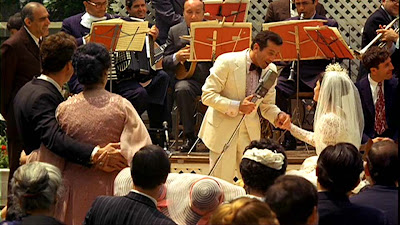
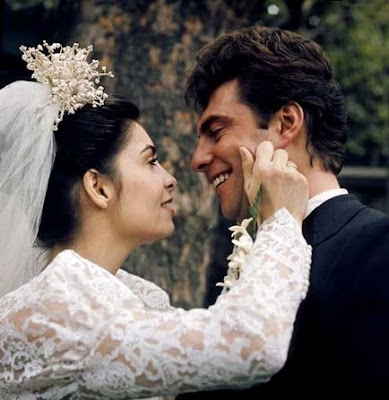
When watching the Godfather, it was easy for me to be put in the place of the setting. Unlike The Diving Bell and the Butterfly angle shots that placed me in Jean-Do’s paralyzed position, The Godfather used props and sets to enhance the setting. The opening setting is a 1940’s Italian family’s wedding. Without words, I was able to tell that I was in a different decade and I could identify that they are wealthy. Through the dresses and suits (typical in the 40’s fashion... and so fashionable nowadays), I was able to tell that the outfits (costumes) are quality material and the number of layers/lace on the actual wedding gown seemed to cost a lot. Plus, the decorations (balloons and flowers) were extraordinarily expensive. I worked in a flower shop for years and I know the price of each stem of calla lily, rose, lisianthus, etc, in the arrangements. These are not cheap flowers, even for now. And since shipping/transporting flowers internationally was not available as it is now, it would have been that more expensive and rare to have these. Besides the expensive flowers, the cars in the driveway also are lined up. It is almost as if everybody has money and they all can afford nice cars. The number of guests is exorbitant as well. I am aware that they have a large family, but they all fit outside the Corleone’s house which makes the Corleone’s live in on a lot of land and have a lot of guests to pay for. The band to entertain the party guests fits along with the decade and also it is a large sized band. Even now, I don’t think I will be able to afford such a large band. The last thing about the wedding which shows that they are wealthy/influential and the people surrounding them are wealthy is the size of the cake. The cake is extremely tall and many layers to it. All of these props may seem unimportant and microscopic, but they all convey the naturalistic idea that this family has power and money. This is one of the opening scenes and it shows that there wealth and affluence to this family. I understood of all that from about 15 minutes of the movie. I understood the time period and the social status.

Tuesday, September 29

Analysis of Apocalypse Now


Apocalypse Now has a few main aspects of cinematography in which it is recognized and distinguished as a great movie, espec
ially the aspects of color. For one, the color of the movie was a constant reminder of how choosing a color scheme can be so powerful. In the beginning of the movie, we view Captain Willard as he waits for his mission. Once he gets the mission and heads to the jungle, there is an obvious visual pattern in the jungle and the war, fire (yellow, oranges, reds). Fire has been consistently been part of the movie. The beginning of the movie shows blood as he punches the mirror and then there is the shrimp while he gets his mission. Then he is stuck in war and there is clearly lots of blood and fire there. In fact, Lieutenant Colonel Bill Kilgore (the surfer) wears a yellow scarf around his neck.


And it continues until Captain Willard gets really deep until the jungle. When he gets close to the crazy Kurtz, the scene gets very dark and misty. There is a lot of fog and darkness. Once he reaches the ruined city Kurtz changed, there is a lot of yellow and oranges in the city. I think it is supposed to resemble the fires that are burning (which also are symbolic) and the reflection from those fires. From the camera angles and highlighting this, it makes it obvious that the colors are not a coincidence, it was planned and arranged.


Then, it is clear how yellow and shadowing cinematography is used when the climax happens. When Capt Willard finally finds Kurtz, there is not a full shot of his looks for a while. I get snippets and undistinguishable angles of him in which I cannot form a look together. By not being able to see his full face, it is very difficult for me to personify Kurtz. The yellow makes it seem much more glum and conveys the image in which Kurtz has more power and fierceness than he actually does. By planning and organizing the shadowing, it changes the basic image and it changes the emotion it makes. Personally, I feel as if Kurtz is more inhuman and much more evil because I cannot picture him as a human. I cannot picture him as a man and performing such horrific acts to the village members. Once I do view Kurtz, he isn’t so scary and intimidating, I do not feel as if his evil is omnipotent anymore. Through the cinematography, a different angle

may evoke a different feeling and mindset towards the story.

Tuesday, September 22

Analysis of The Diving Bell and the Butterfly

After watching The Diving Bell and the Butterfly, I already had a first impression of the movie. Overall, I thought it was a beautifully sad and moving life. The second time I watched this I realized that the movie had many more dimensions that just the characters’ interaction and development. For one, the opening scene has a very blurry frame and it is set at a very low point of view. From this low position, I am expected to feel like I am actually the character, Jean-Do, who is in a hospital bed. The camera movement, most likely on a handheld, is accurate in the sense that it attempts to portray what a paralyzed person feels. No movement of the “neck” (handheld, again) allows the attention to be on the focus and depth of field. In this opening scene, not only is the camera position low, but also the depth of field is very limited. At most, a hospital room is 10 feet from the bed to the end of the room. Ten feet does not provide a very spacious feeling, rather, it feels claustrophobic and constraining. Also, Jean-Do’s “eyes” attempt to take in as much information as possible, so they range from a very deep focus to a very blurry shot. This iris shot directly relates to how Jean-Do experiences his new perspective. At one point, we see the stubble on a doctor’s face and we can almost see ear hair. If anybody has ever had to get their eyes checked and they get the eye drops, this is what the camera does. It goes from very blurry, almost as if there is a water-like film over the vision, to a very crisp deep focus. The position of the camera, paired with the deep/lack of focus and limited depth of field conveys the constraining feeling one feels in a hospital bed. From Jean-Do’s position of the hospital bed, it also has very skewed angles, also known as canted frame. It is obvious that the camera is a handheld and not set on a tripod well until the second or third scene. This could symbolize how Jean-Do is unconscious and unstable (handheld) to when he begins to recognize and consciously understand his surroundings (tripod). Overall, the beginning shot to me was one of the most important because it easily set me into his position. I could already relate to Jean-Do because I have experienced the constricting hospital room setting. Being put into Jean-Do’s head was a brilliant and effective idea for me to easily share and associate myself with the main character. Je suis dans la tĂȘte du Jean-Do!